Introduction
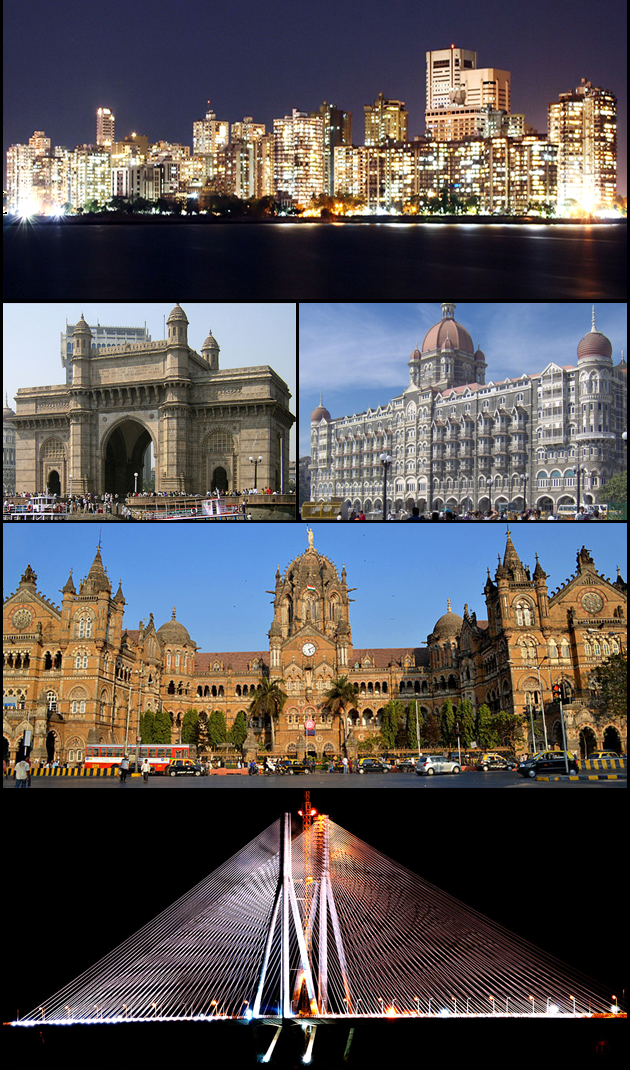
Mumbai (Bombay) is the capital city of the Indian state of Maharashtra. With an estimated population of over 12.4 million (and counting) it was named as an alpha world city in 2008. It is home to the highest number of millionaires and billionaires in India. Its culture is a blend of traditional festivals, food, music and theaters. The city offers a cosmopolitan and diverse lifestyle with a variety of food, entertainment and night life. This is a city which never sleeps.
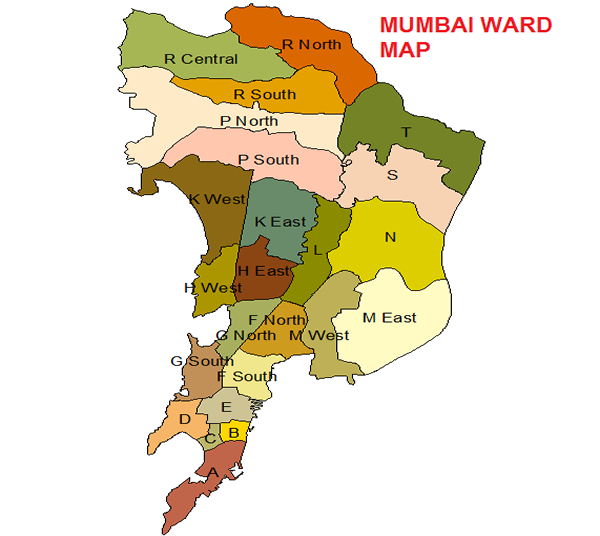
For the study, I have considered data spread across the major 23 municipal wards in Mumbai.
As the study is around finding a prospective location for opening a Fine Dine Restaurant, it was interesting to observe some of the below statistics. This data was purely to get a sense of what a person might spend on a Fine Dine experience.
- Four-person family monthly costs: USD 1,295 without rent
- A single person monthly costs: USD 370 without rent
- Cost of living rank 349th out of 388 cities in the world
- A fine dine food experience on an average would cost USD 120 to 140 per person per meal
- Mumbai has a cost of living index of 29.41
Business Problem
Mumbai being the financial capital of India has several large conglomerates which houses many professionals, visiting foreign delegates, heads of institutions and organizations who sometimes opt for Fine Dine restaurants as extended work areas to have business related discussions over good food and wine. Through this study, we will go through the pro’s and con’s of opening a Fine Dine restaurant in one of the major wards of Mumbai.
Usually, the Fine Dine restaurants are priced between USD 250 to 300 per meal, which includes appetizers and some light beverages. The profit margin that the restaurants usually make is in the range of 25% to 35%. There is very stiff competition to such Fine Dine restaurants, not only from their segments but also from other eating places E.g. Sports bars, local traditional restaurants, Pizza places, Coffee Houses and many such eating joints which provide good food and ambiance for the customers.
Target Audience
- Entrepreneurs and business professionals who would like to venture into the restaurant business. This analysis should give an idea to start a Fine Dine restaurant in one of the major places in Mumbai.
- Small investors who have a passion for food and would want to start their own restaurant business.
- Office goers, college students or people from all walks of life, who would like to take their colleagues, clients, foreign visitors for a fine dining experience which would be convenient to reach from an office.
Data Preparation
Extracting Data from different sources
We would scrape information from the site hosted on the Mumbai Wards and Districts (http://www.demographia.com/db-mumbaidistr91.htm) and create a data frame. We would be using “requests” and “Beautifulsoup4library” to create a data frame with all the wards, area, population and density per square mile of Mumbai.
For the data analysis, I have considered 23 Mumbai wards. The data extracted, provides statistics around the number of households, population, land in square miles and the density per square mile.
Additionally, we will also refer to another website for getting the Commercial Rates per Square Mile in Mumbai (https://www.mumbaipropertyexchange.com/research/mumbai-property-carpet-area-rates) and create a data frame. Get the co-ordinates of these 23 major districts using geocoder class of Geopy client. Few of the districts returned incorrect co-ordinates for the latitude and longitude. So, the area values had to be corrected with the right values.
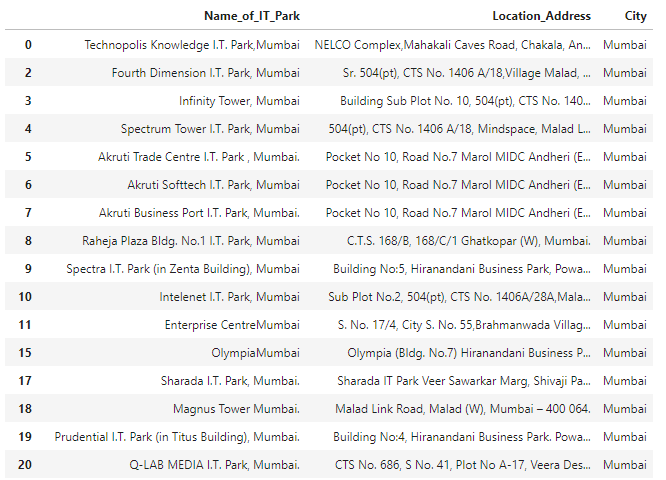
I have also referred to a list of IT/ITES parks registered in Mumbai. This would give us an idea of a potential number of customers in a particular area.
Data Cleansing
There were multiple problems with the data that was extracted from the website. Several names of the districts were incorrectly spelled, because of which the Foursquare API didn’t return the right co-ordinates. Additionally, there were multiple white-spaces, new line carriage feeds, special characters e.g. “[,]” which had to be first cleansed. Once the names were standardized, I noticed that the Foursquare API was returning incorrect latitude and longitude values. So, for such outlier cases, I had to first do a Google Search to get the right co-ordinates and then I had to manually replace the value for that district.

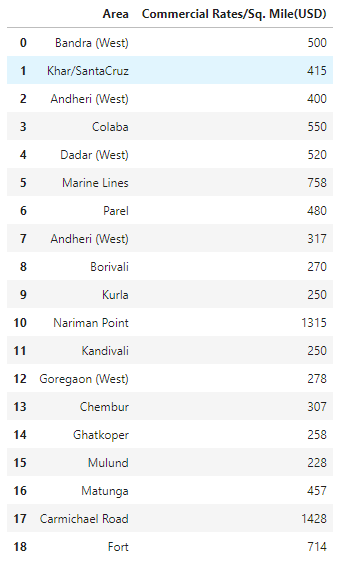
The second set of data which I have used is to provide the property prices of Commercial land in Mumbai to identify which place would be economical from an infrastructure perspective.
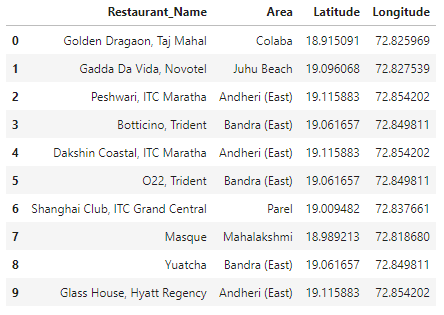
Additionally, I have also compiled a list of 10 most expensive fine dine restaurants in Mumbai. Source – https://www.dineout.co.in/blog/2016/12/12/top-10-places-luxury-dining-mumbai/
In addition to the above 2 data sets, I also extracted a list of IT parks that are registered under IT/ITES in Mumbai (Source – https://di.maharashtra.gov.in). This data revealed that there are 161 such IT parks with over 500+ people working in each of these. Thus, there is a high probability that this segment of customers catering to a global clientele would visit Fine Dine restaurants frequently.
One of the challenge was that the address for these IT/ITES parks was not standardized and was in a free text format. Thus, the city name and area had to be extracted by use of regular expressions.
Methodology
Exploratory Data Analysis
It wasn’t surprising to see that the most frequently visited venues was Indian Restaurants. However, this data did not reveal that these restaurants were Fine Dine places. It wasn’t very conclusive if these restaurants provided only comfort food, local food or did any of these actually provide a Fine Dine experience.

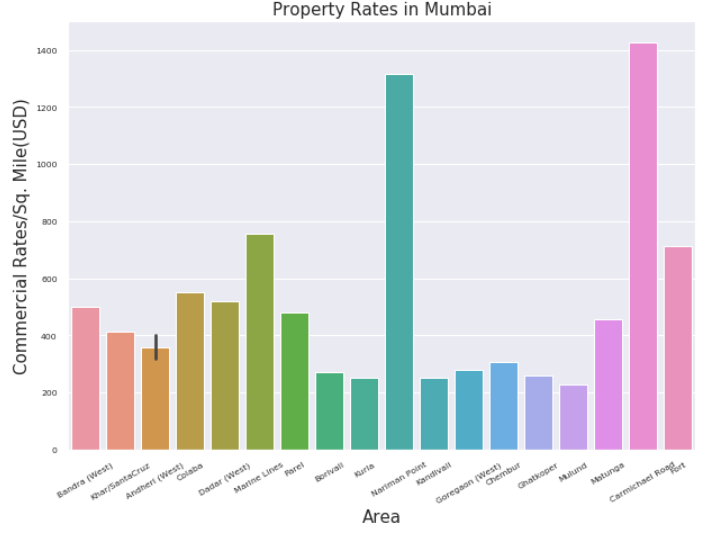
Commercial Property prices in Mumbai are among the world’s most expensive. So, before narrowing down on a location it was important to compare property prices in Mumbai. Having lived in Mumbai, it wasn’t surprising that Downtown Mumbai (aka Fort) had the highest commercial property rates. Whereas, most of the major suburbs where lot of the IT/ITES parks are located had significantly lower property rates.
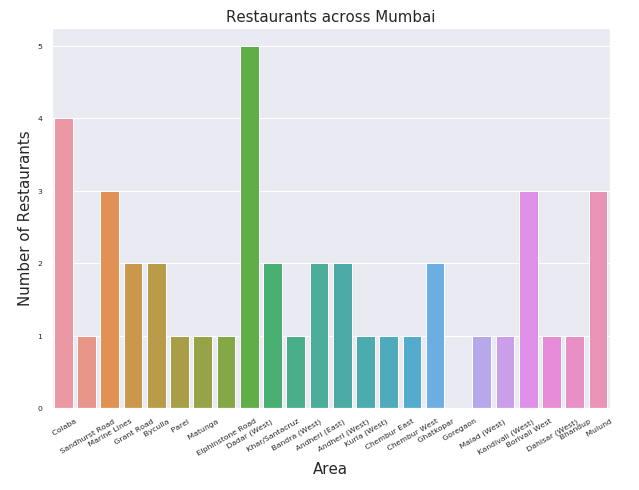
As part of the analysis, I have included the following as part of the search criteria for restaurants in Mumbai viz. Indian, Thai, Chinese, Italian, French, German, Modern European, Moroccan, Mediterranean, Maharashtrian, Molecular Gastronomy and Restaurants. There could be other eating joints which may not have been accounted for in these criteria e.g. Snack places, Tea Room, Cafeteria, Comfort Food Place, Pizza Place, Coffee Houses, etc. Intent is to have a data set which potentially might offer a unique Fine Dining experience in Mumbai.
Correlation between popular Venues and Restaurants
Movie Theater vs. Thai Restaurants
When I ran a Pearson correlation between a Movie Theater and a Thai Restaurant, I observed that the P-value of 0.011 was < 0.05 which showed that there is moderate evidence that there exists a correlation between the presence of a Thai Restaurant near a Movie Theater.
Park vs. Molecular Gastronomy Restaurant
When I ran a Pearson correlation between a Park and a Molecular Gastronomy Restaurant, I observed that the P-value of 0.099 was < 0.1 which showed that there is weak evidence that there exists a correlation between the presence of a Molecular Gastronomy Restaurant near a Park. However, this may be incorrect as there was only one restaurant in this category, so there wasn’t enough sampling to arrive at the right result.
Scenic Lookout vs. Italian Restaurant
When I ran a Pearson correlation between an Italian Restaurant and a Scenic Lookout venue, I observed that the P-value of 0.0008 which was < 0.001 which showed that there is strong evidence that there exists a correlation between the presence of an Italian Restaurant with a Scenic Lookout.
It was interesting to notice that some of the popular Italian restaurants were located near the seashore or near a heritage site which was a popular tourist attraction.
Spa vs. German Restaurant
I observed that the P-value of 0.0002 which was < 0.001 showed that there is strong evidence that there exists a correlation between the presence of a German Restaurant with a Spa in its neighborhood.
Descriptive Statistical Analysis
It was interesting to observe that Kandivali (West) had the greatest number of Indian Restaurants and Fast Food Restaurants. With a very high density per square mile, it had the maximum number of eating joints.

Linear Relationship
To understand the linear relationship between number of households and land area per square mile, I have used “regplot” which plots the scatter plot plus the fitted regression for the data.
With a very large population of Mumbai and very scarce land, below result was obvious that a large number of households resided in larger land areas.

Visualize the Clusters on the Mumbai Map
The major districts of Mumbai were categorized into 5 clusters.
- Cluster 1 – Kurla (West)
- Cluster 2 – Grant Road, Parel, Elphinstone, Khar/Santa Cruz, Bandra (West), Kandivali (West)
- Cluster 3 – Goregaon
- Cluster 4 – Matunga, Chembur, Malad, Bhandup
- Cluster 5 – Colaba, Dadar, Marine Lines, Mahim, Borivali, Andheri

Most frequently visited Restaurant Types in the major districts of Mumbai
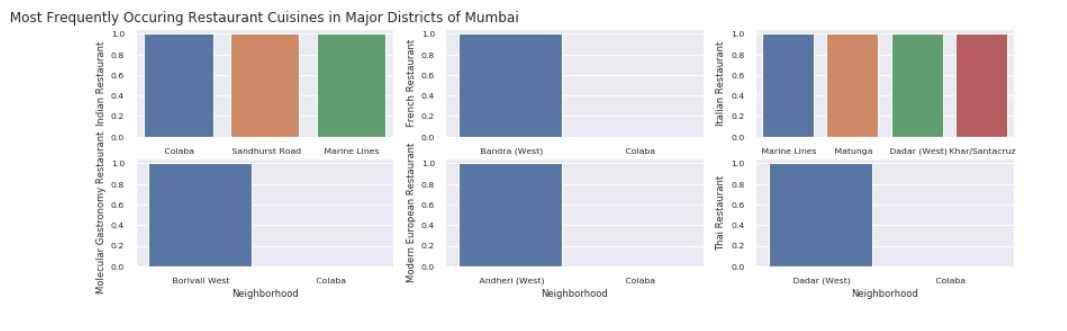
Interestingly, Indian restaurants being the most frequented, Italian restaurants were the 2nd most common restaurants visited.
Plotting the Top 10 Most Expensive Restaurants in Mumbai
During my analysis, some of the Fine Dine websites suggested that the following restaurants were the 10 most expensive restaurants in Mumbai. So, we should look at other major areas to open a new Fine Dine restaurant which could be in this league of restaurants.
- Golden Dragon, Taj Mahal, Colaba
- Gadda Da Vida, Novotel, Juhu Beach
- Peshwari, ITC Maratha, Andheri (East)
- Botticino, Trident, Bandra (East)
- Shanghai Club, ITC Grand Central, Parel
- Masque, Mahalakshmi
- Yuatcha, Bandra (East)
- Glass House, Hyatt Regency, Andheri (East)

Results and Discussions
Based on the data analysis performed on the major districts of Mumbai, to arrive at a conclusion of the business goal to open a fine dining restaurant in Mumbai, the data exploration was done on types of restaurants e.g. Indian, French, Chinese, Mediterranean in some of the major districts of Mumbai like Bandra, Khar/Santacruz, Colaba, Marine Lines and Borivali (West).
From the data received through Foursquare, Geopy we have found that: –
- Indian restaurants are the most common venues across the major districts of Mumbai.
- Bakeries come a close second followed by Pizza places, Snack joints, cafe’s and Chinese restaurants.
- There are very few fine dining restaurants in the category of French, German, Moroccan, Modern European and Molecular Gastronomy Restaurant.
- Marine Lines, Matunga, Dadar, Khar/Santa Cruz and Bandra (West) are the only places in Mumbai which have any European Restaurants which typically offer fine dining restaurants.
- There is only one Molecular Gastronomy Restaurant in Borivali West and a Modern European Restaurant in Andheri (West).
- 70% of the top 10 most expensive fine dine restaurants are in Mumbai Western Suburbs. The main driver behind this would be comparatively lower commercial property rates as compared to Downtown area.
- However, some of the restaurants in the downtown area are in places where once stood industries, warehouses and mills which were closed, and the land was brought at very low rates.
- Property rates in Carmichael Road, Colaba and Fort are the highest in terms of per sq. mile commercial rates.
- Property rates in suburbs like Borivali, Kurla, Kandivali, Mulund and Ghatkopar are the lowest.
Conclusion
Based on the analysis, the data suggests that keeping in view the property rates across the major districts of Mumbai and the frequently visited restaurants, the recommendation would be to open a Fine Dining restaurant in one of the suburbs of Mumbai like Kurla, Ghatkopar, Borivali and Mulund serving either Italian, French, German or any other Modern European food. Another option would be to open a Molecular Gastronomy Restaurant in one of the suburbs as it seems to be a frequently visited and popular venue in Mumbai.
The analysis could be further improved based on gathering survey data from different customer segments based on age, working / student, culinary tastes, budget, etc.
 Prospects of Opening a Fine Dine Restaurant in Mumbai (Capstone): Data Science